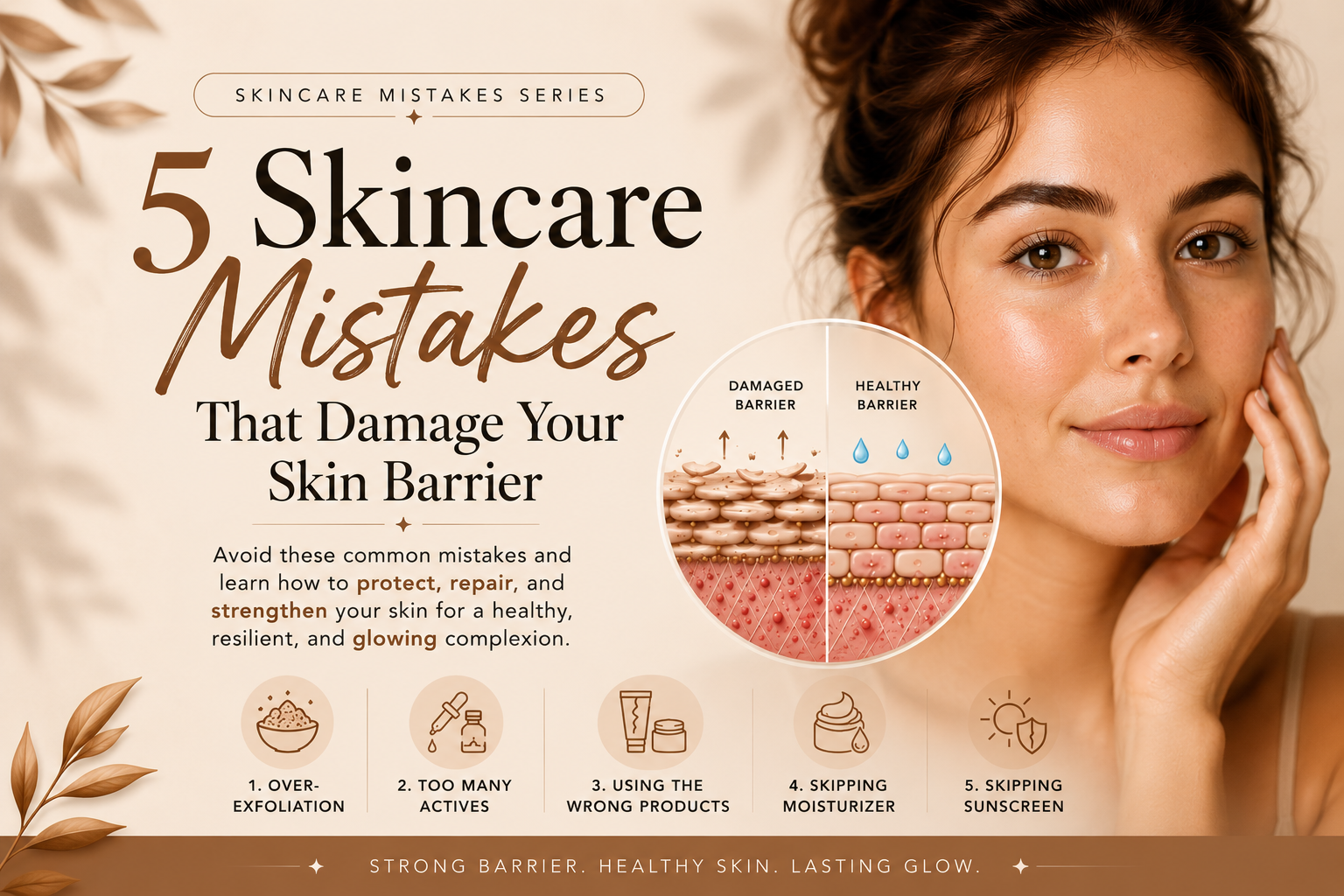
Category: skincare mistakes

  • 5 Critical Mistakes That Shattered Your Skin Barrier (And How to Heal It)

    5 Critical Mistakes That Shattered Your Skin Barrier (And How to Heal It)


    I’ve spent the last three years watching people destroy their skin in the name of clarity.

    They come to me frustrated, confused, sometimes even angry. “I’m doing everything right,” they say. “I’m exfoliating twice a week. I’m using active ingredients. I’m following every skincare trend I can find.” And yet their acne is getting worse. Their skin is red, itchy, flaking — sometimes even burning.

    The real problem? They have skin barrier damage, and they don’t even know it.

    What’s cruel about skin barrier damage is that it usually happens to the people who care the most about their skin. The ones who read every article, buy every serum, and genuinely want to fix their acne. They’re so focused on treating breakouts that they accidentally obliterate the protective wall their skin needs to actually heal.

    Here are the five critical mistakes most likely causing your skin barrier damage — and exactly what to do about each one.


    Why Skin Barrier Damage Matters More Than Any Serum You Own

    Before we get into the mistakes, let’s be clear about what skin barrier damage actually means.

    Your skin barrier isn’t just a skincare buzzword. It’s the difference between healthy, clear skin and a relentless cycle of inflammation, sensitivity, and persistent acne. Think of it like the security system of your house: when it’s working, it lets good things in (hydration, beneficial ingredients) and keeps bad things out (bacteria, pollutants, irritants). When you have skin barrier damage, that system breaks down. Water escapes. Irritants penetrate. Inflammation follows. And your acne doesn’t stay the same — it gets worse.

    According to the American Academy of Dermatology, a healthy skin barrier is the foundation of resilient, youthful skin — and harsh routines are one of the leading causes of damage. Research suggests approximately 60% of people with acne are actively causing skin barrier damage while trying to treat their breakouts. They’re using the right ingredients in the wrong way, and they don’t realize it until the problem is severe.


    Mistake #1: Over-Exfoliating (Leading Cause)

    Over-exfoliation is responsible for more cases of skin barrier damage than any other single factor, and it almost always happens with the best intentions.
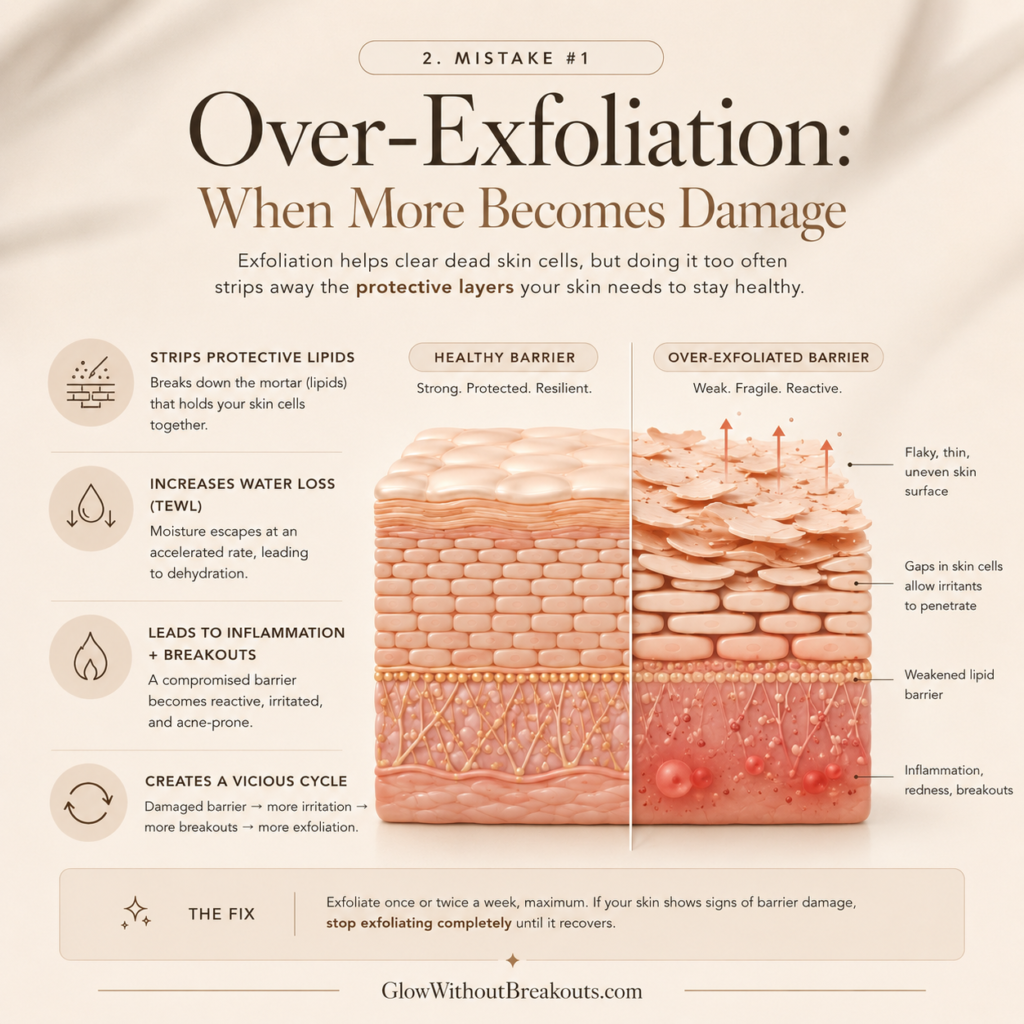
    The messaging around exfoliation isn’t wrong — removing dead skin cells does unclog pores and smooth texture. But nobody emphasizes the difference between healthy exfoliation and the kind that strips away the protective lipids your skin needs to function.

    Here’s what’s happening beneath the surface. Your outermost skin layer — the stratum corneum — is made up of dead skin cells held together by lipids: ceramides, cholesterol, and fatty acids. Think of it as a brick wall, where the cells are the bricks and the lipids are the mortar. When you over-exfoliate, you’re not just removing bricks. You’re dissolving the mortar too — and that’s how skin barrier damage begins.

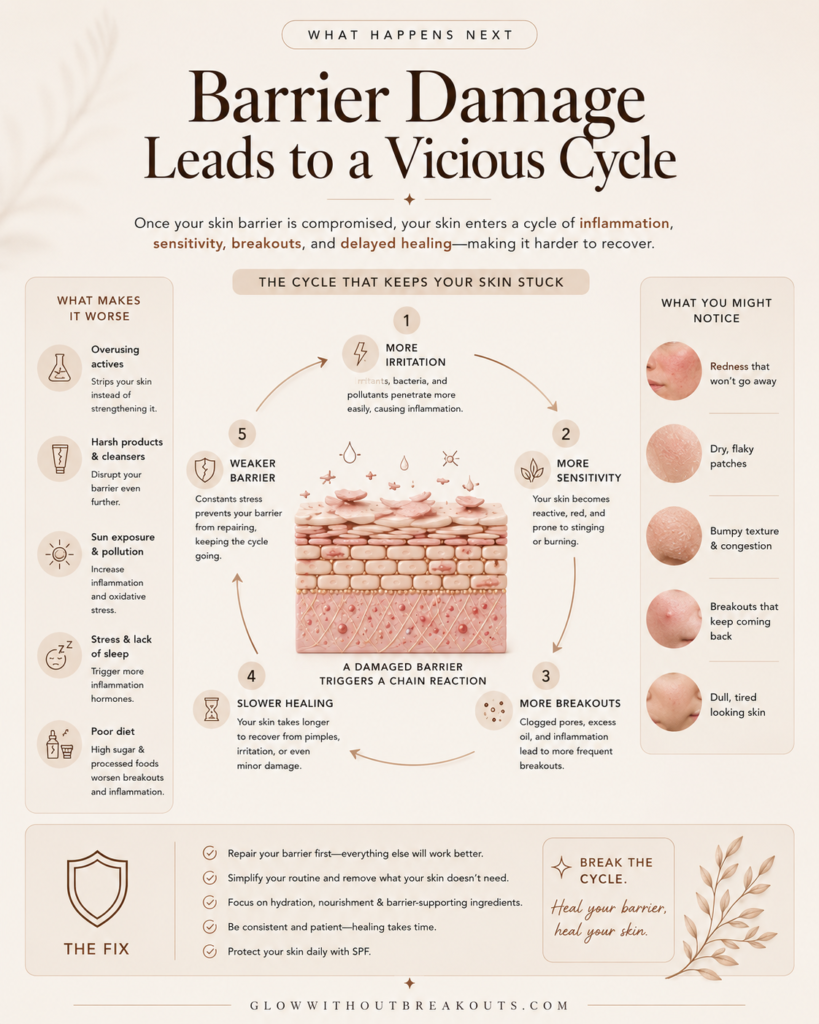
    The result is elevated transepidermal water loss (TEWL). Your skin starts leaking moisture at an accelerated rate, even if you’re applying moisturizer. Dehydrated skin is inflamed skin. Inflamed skin is acne-prone skin. This is the vicious cycle that skin barrier damage creates.

    I see this pattern constantly. Someone exfoliates twice a week, gets results, bumps it to three times, then adds a physical scrub. Within a few weeks their skin is red, reactive, and breaking out worse than before. They assume they need stronger acne treatments and add a retinoid or benzoyl peroxide on top of already serious skin barrier damage. By that point, recovery takes months.

    The fix: Most skin types do well with exfoliation once or twice a week, maximum. If you already have signs of skin barrier damage, stop exfoliating entirely until your skin recovers. For a full step-by-step guide to getting your skin back on track, read our post on Over-Exfoliation Recovery: How to Fix Damaged Skin.


    Mistake #2: Combining Too Many Active Ingredients

    Here’s another common path to skin barrier damage: layering multiple active ingredients in the same routine.
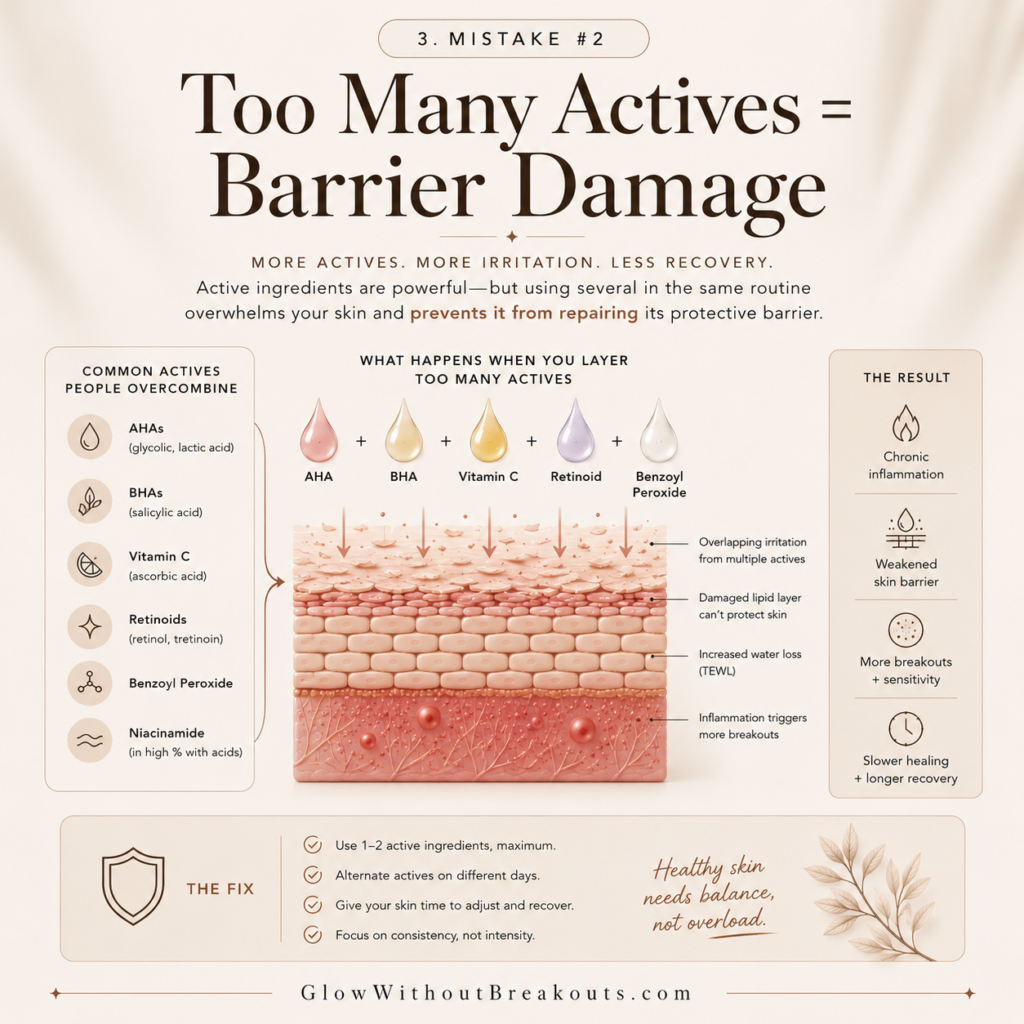
    Active ingredients — AHAs, BHAs, vitamin C, retinoids, niacinamide, benzoyl peroxide — are powerful tools. But they’re all, by definition, irritating to some degree. One active ingredient gives your skin time to adapt and recover. Three or four in the same routine creates progressive skin barrier damage, day after day, with no recovery window.

    I had a client using a BHA toner, vitamin C serum, nightly retinoid, and benzoyl peroxide spot treatment all at once. Within two weeks she had severe skin barrier damage — her skin burned at the touch of anything. She’d developed contact dermatitis, her acne was significantly worse, and her recovery took months longer than it needed to.

    The problem isn’t just the immediate irritation. Constant chemical disruption keeps your skin in a perpetual state of inflammation, making it impossible to repair the existing skin barrier damage.

    The fix: Use one to two actives maximum, on alternating days. If your skin is already irritated, strip your routine back to basics until it stabilizes. For a deeper look at how daily habits quietly worsen breakouts, read our post on the 8 Best Tips to Prevent Breakouts and Acne.


    Mistake #3: Using the Wrong Cleanser

    This one surprises people, but it shouldn’t. Your cleanser is the first product you use every single day — if it’s too harsh, you’re creating skin barrier damage twice daily before you even get to your other products.
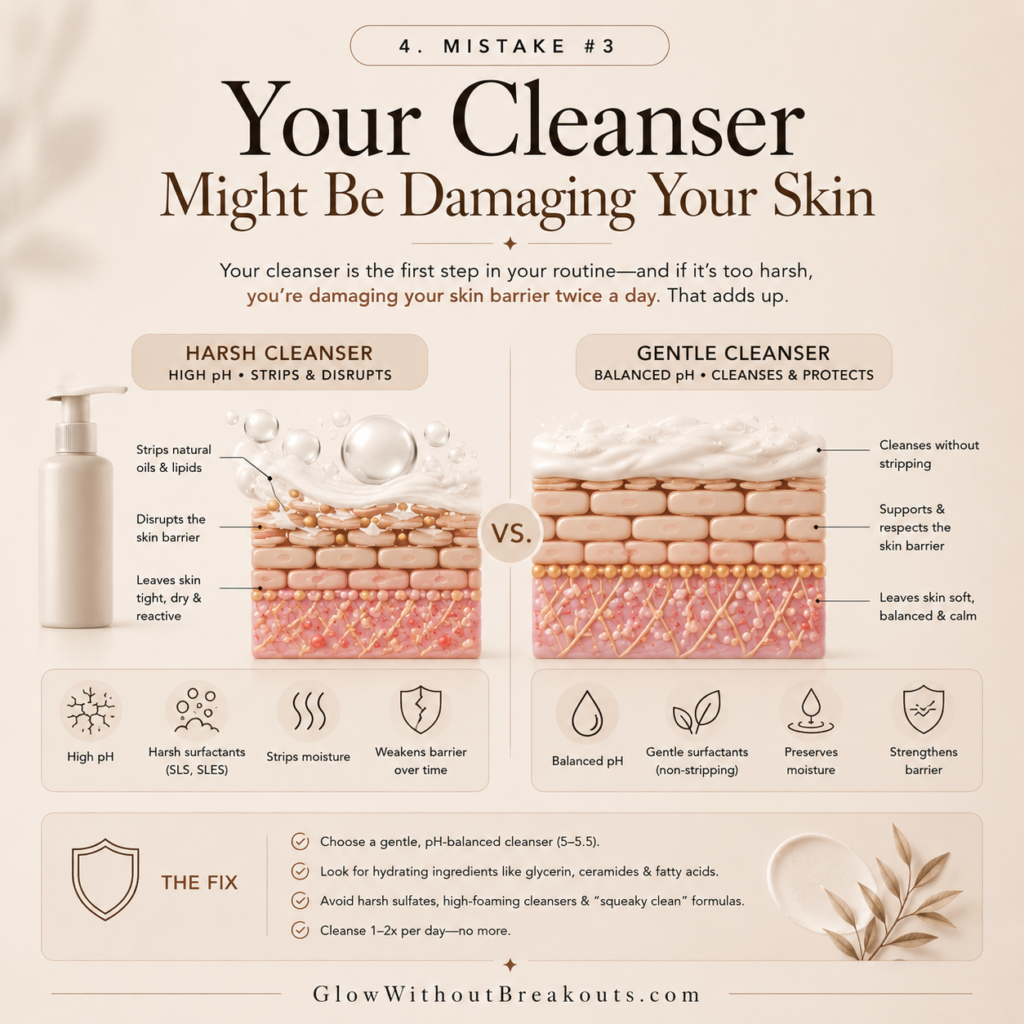
    Most commercial cleansers use surfactants that don’t discriminate between excess surface oil and the essential lipids that make up your barrier. High-pH cleansers (above 7), sulfates, and alcohol also disrupt the acid mantle — the slightly acidic environment that keeps your microbiome balanced. Used twice a day, these cleansers cause cumulative skin barrier damage with every wash.

    Many people think the tight, squeaky-clean feeling means the cleanser is working. It doesn’t. That feeling is skin barrier damage happening in real time.

    The fix: Switch to a gentle, pH-balanced cleanser (around 5.5). Oil cleansers and non-foaming gel or cream formulas are excellent choices. Your skin should feel clean after washing — not tight or uncomfortable. Not sure which cleanser is right for you? We tested and ranked six popular options in our guide to the Best Cleansers for Acne-Prone Skin. And if you’re curious about oil cleansing, our guide to Oil Cleansers for Acne-Prone Skin explains why it might be the gentlest option for a compromised barrier.


    Mistake #4: Ignoring the Warning Signs of Skin Barrier Damage

    Your skin communicates constantly. The problem is that most people don’t recognize what skin barrier damage actually looks and feels like — so they respond to the warning signs by making things worse.

    Classic signs of skin barrier damage include:
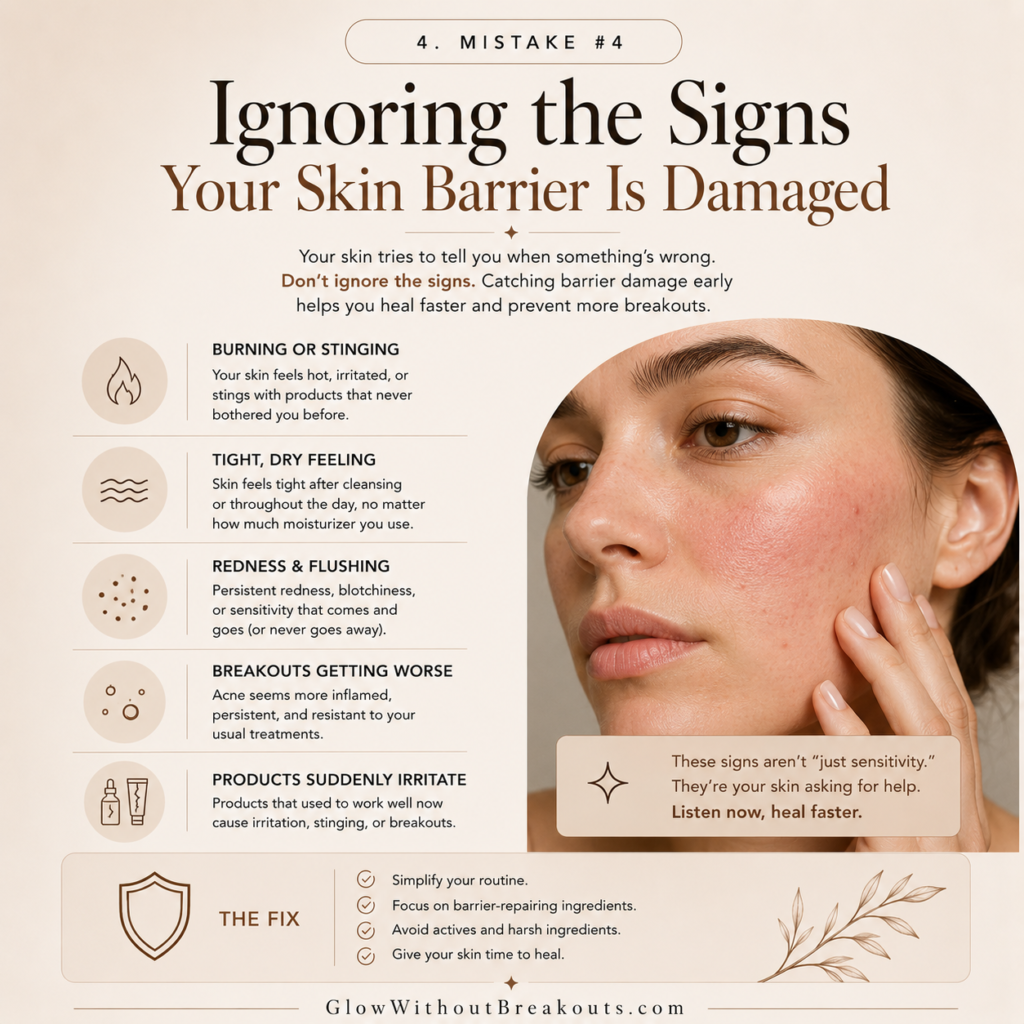
    • Products that never bothered you before now sting or burn
    • Skin feels tight and uncomfortable even after moisturizing
    • Increased redness or flushing after applying products
    • Itching or a rough, bumpy texture
    • Acne that’s worsening despite consistent treatment

    That last point is what derails people most often. When acne flares, the instinct is to reach for stronger treatments. But if that flare is being driven by skin barrier damage, adding more actives is exactly the wrong response. You’re treating the symptom while accelerating the underlying problem.

    I’ve worked with people who had signs of skin barrier damage for months before addressing it — rationalizing the sensitivity, dryness, and breakouts as their treatments “working.” By the time they tackled the root cause, recovery took far longer than it needed to.

    The fix: When these signs appear, simplify immediately. The earlier you catch skin barrier damage, the faster it heals.


    Mistake #5: Not Actively Rebuilding During Skin Barrier Damage Recovery

    This is the mistake that turns a 4-week recovery into a 4-month one.

    Let’s say you’ve stopped over-exfoliating and cut back on actives. Good start. But if you’re still using a stripping cleanser, or your moisturizer doesn’t contain the lipids your skin needs to rebuild, you’re just slowing the harm — not reversing it.
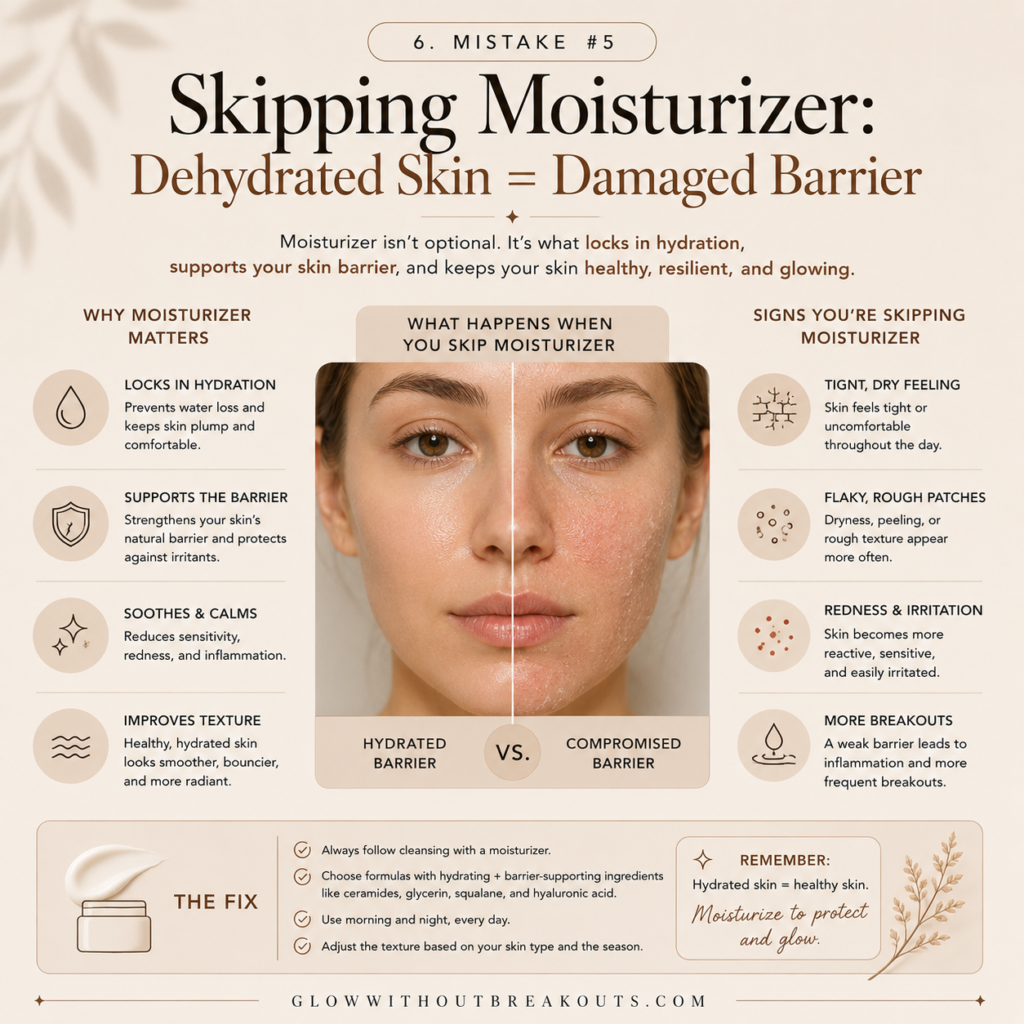
    Recovering from skin barrier damage is not a passive process. Your barrier is made of ceramides, cholesterol, and fatty acids. When those are depleted, you have to actively replenish them. Stopping the harm is step one. Rebuilding is step two.

    Here’s where most people go wrong: they reach for a lightweight hydrating moisturizer with glycerin or hyaluronic acid. It sounds right, but it doesn’t address the structural problem. Humectants pull water into your skin, but if there’s no lipid layer to hold it there, it evaporates right back out. To properly repair skin barrier damage, you need a barrier-repair moisturizer — something with ceramides, cholesterol, or fatty acids that rebuilds the structure rather than just temporarily plumping it.

    The fix: During skin barrier damage recovery, use products formulated specifically for barrier repair. Three solid options:

    • CeraVe Moisturizing Cream — formulated with three essential ceramides and developed with dermatologists specifically to restore the skin barrier
    • La Roche-Posay Cicaplast Balm B5+ — a soothing multi-purpose balm with panthenol and madecassoside that actively helps repair dry, irritated skin
    • Aveeno Eczema Therapy — fragrance-free with colloidal oatmeal, accepted by the National Eczema Association

    Look for ceramides, cholesterol, or fatty acids high on the ingredient list.


    What’s Happening at the Cellular Level

    Understanding the science helps explain why skin barrier damage recovery takes as long as it does — and why you can’t rush it.
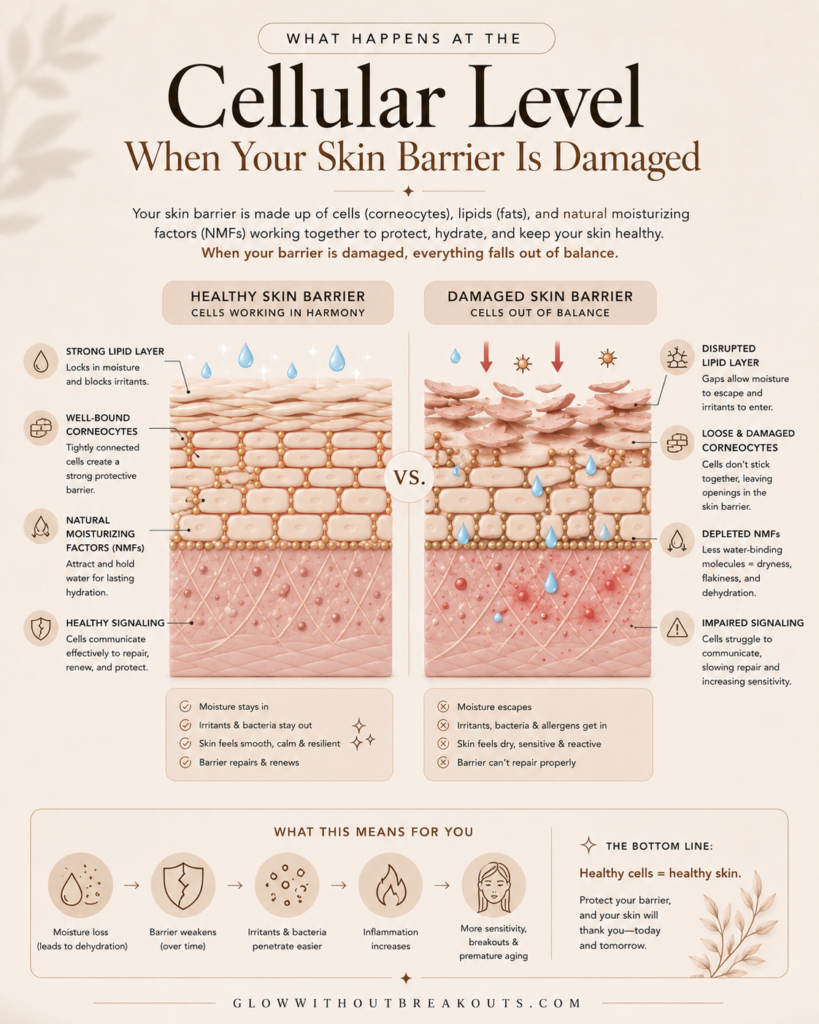
    The stratum corneum is only 10 to 20 micrometers thick, but it does all the heavy lifting. When skin barrier damage disrupts its “brick and mortar” structure, four things happen simultaneously:

    TEWL spikes. Healthy skin loses 10–15g of water per square meter per hour. With significant barrier damage, that can reach 50–100g. Your skin is leaking moisture constantly.

    pH rises. Healthy skin sits at 4.5–5.5. Skin barrier damage pushes pH toward neutral, creating conditions where harmful bacteria thrive.

    Ceramide synthesis slows. When skin barrier damage is severe, damage outpaces your skin’s natural repair process.

    Inflammation activates. Your skin releases cytokines that cause the redness, swelling, and sensitivity you feel.

    These processes don’t stop the moment you put down the irritating product. This is why recovery typically takes 4 to 8 weeks even when you do everything right. For a deeper look at the science, Healthline’s guide to skin barrier function is a well-researched overview worth bookmarking.


    How Severe Is Your Skin Barrier Damage?

    Mild: Increased sensitivity to familiar products, occasional tightness, some redness after actives that settles quickly. Your barrier is partially compromised but still functional.

    Moderate: Visible redness, burning or stinging with most products, rough texture, increased breakouts. Your natural defenses are struggling.

    Severe: Extreme reactivity, stinging from water, intense itching or flaking, eczema-like symptoms, significantly worsening acne. Your barrier can no longer protect you effectively.

    Recovery timelines:

    • Mild skin barrier damage: 2–3 weeks
    • Moderate skin barrier damage: 4–6 weeks
    • Severe skin barrier damage: 8–12 weeks
    The 4-Week Skin Barrier Damage Recovery Protocol

    Week 1: The Reset

    Strip your routine down to three steps: a gentle cleanser, a hydrating toner, and a barrier-repair moisturizer. No exfoliants, no retinoids, no actives of any kind.

    • Cleanser: pH-balanced (around 5.5), oil-based or creamy non-foaming. Cleanse with your hands, not a cloth.
    • Toner/essence: Simple humectants — glycerin, hyaluronic acid, or panthenol.
    • Moisturizer: Ceramide-containing formula to begin repairing skin barrier damage. CeraVe Moisturizing Cream, La Roche-Posay Cicaplast Balm B5+, and Aveeno Eczema Therapy are all reliable options.

    Avoid hot showers, steam, and prolonged water exposure — all of which worsen skin barrier damage. Lukewarm water, brief contact, hands only.

    By the end of week one, the most acute symptoms — burning and stinging — should start to ease.

    Week 2: Introducing Active Repair

    Keep your week-one routine and add two things:

    • A niacinamide serum (4–5%). Particularly effective for skin barrier damage recovery because it helps your skin synthesize more of its own ceramides, rebuilding from the inside out.
    • An occlusive. A facial oil, balm, or thin layer of Vaseline or Aquaphor at night seals everything in and dramatically reduces moisture loss.

    Still no actives. By the end of week two, redness should be visibly decreasing.

    Week 3: Carefully Reintroducing Actives

    Your barrier is stabilizing. You can begin reintroducing one gentle active, conservatively:

    • BHA: 2% salicylic acid, once per week
    • AHA: 5–8% concentration, once per week
    • Retinoid: Lowest available concentration, once or twice per week. If you were on prescription tretinoin, start with an OTC retinol to avoid re-triggering skin barrier damage.
    • Benzoyl peroxide: 2.5%, spot treatment only

    One active. Low frequency. Two full weeks before considering any increase.

    Week 4: Gradual Progression

    You can increase your active to twice per week if symptoms haven’t returned. You can introduce a second gentle active if needed — but keep them on separate days to avoid fresh skin barrier damage.

    Recovery isn’t perfectly linear. If your skin flares when you increase something, dial it back. That’s not failure — that’s the process.

    By the end of week four, your skin barrier damage should be substantially repaired. Once you’re healed and ready to build a long-term routine, our Best Skincare Routine for Acne-Prone Skin gives you a practical step-by-step framework to follow.


    The Bottom Line

    Most acne treatment fails because people unknowingly cause skin barrier damage in the process of fighting breakouts. The acne worsens. They treat it harder. The barrier damage deepens. The cycle continues.

    Once you understand skin barrier damage, everything changes. Healing your barrier isn’t a detour from treating acne — it is the treatment. You cannot build clear, resilient skin on a compromised foundation.

    The recovery protocol works. I’ve seen it work hundreds of times. But it only works if you commit to it, resist the urge to speed things up with stronger products, and trust that your skin knows how to heal once you stop getting in its way.

    Give it what it needs. It will show you.


    FAQ

    How do I know if I have skin barrier damage or irritant contact dermatitis? The distinction is largely semantic. Irritant contact dermatitis is the inflammatory response to skin barrier damage — two sides of the same coin. The treatment is identical: remove the irritant and rebuild the barrier.

    Can I use serums during skin barrier damage recovery? It depends. Avoid anything with actives or fragrance for the first two weeks. In weeks three and four, a gentle niacinamide serum at 4–5% is genuinely helpful. Skip anything with essential oils or exfoliating ingredients until you’re fully healed.

    Is my cleanser causing skin barrier damage? If your skin feels tight or immediately dry after cleansing, almost certainly yes. The right cleanser leaves skin feeling clean but comfortable — not stripped.

    How long does recovery actually take? Mild skin barrier damage: 2–3 weeks. Moderate: 4–6 weeks. Severe: 8–12 weeks. This assumes you follow the protocol consistently and stop using the products that caused the problem.

    Can I use sunscreen during recovery? Absolutely — sun protection is even more important when you have skin barrier damage, since compromised skin is more vulnerable to UV. Choose a mineral formula (zinc oxide or titanium dioxide). Not sure which sunscreen won’t clog your pores? Our roundup of the Best Sunscreens for Acne-Prone Skin covers the top non-comedogenic options.

    What if I see improvement and want to return to my full routine early? Don’t. Visible improvement in week two or three means your skin is healing — not that skin barrier damage is fully repaired. Going back to a full active routine prematurely will re-damage what you’ve rebuilt and restart the clock. And if you’re dealing with an active breakout while recovering, our post on Best Ways to Make a Pimple Go Away Fast covers science-backed methods that are safe to use even on sensitive skin.


    Still unsure whether skin barrier damage is behind your breakouts? Read our post — The Worst Skincare Mistake I Made (And How It Took 7 Years to Fix) — it might sound very familiar.
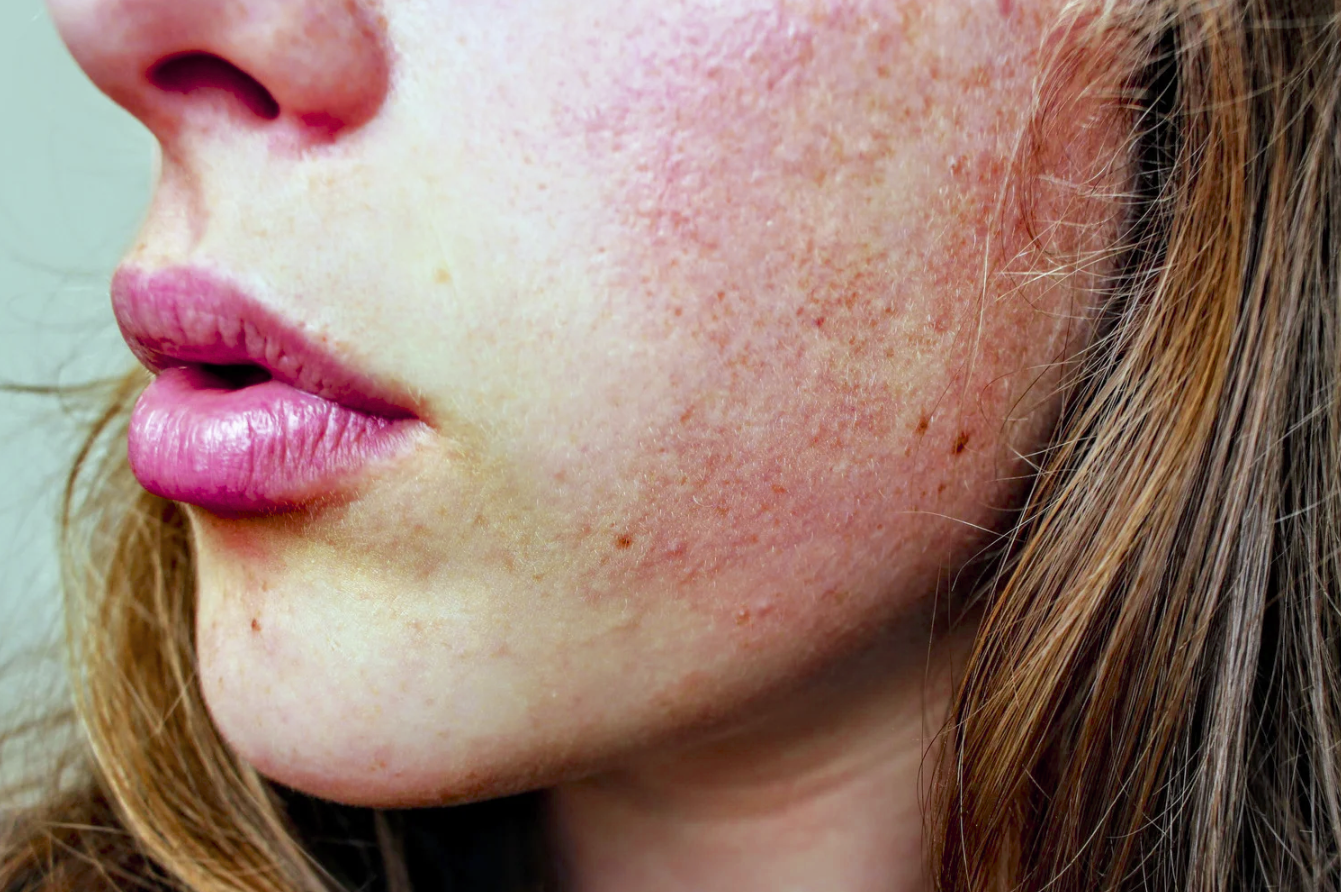

  • 4 Week Over-Exfoliation Recovery: How to Fix Damaged Skin

    4 Week Over-Exfoliation Recovery: How to Fix Damaged Skin

    The barrier damage is real. Here’s the 4-week protocol I used for over-exfoliation recovery, and how to avoid over-exfoliation in the first place.


    Introduction

    Over-exfoliation is one of the easiest skincare mistakes to make because exfoliation feels productive. You’re removing dead skin, unclogging pores, and revealing fresh skin underneath. It feels like progress. But when you do it too much or too aggressively, you cross a line. Your skin barrier (the outermost layer designed to protect you) becomes compromised. You get increased breakouts, persistent redness, sensitivity to everything, and a desperate feeling that your skin has permanently turned against you.

    I’ve been there. I over-exfoliated my skin badly enough that it took a full month of intentional recovery to get back to baseline. I’m sharing exactly what I did during that month, the science behind why over-exfoliation causes acne, and how to exfoliate safely without damaging your skin barrier. If you’re currently dealing with skin over-exfoliation, this protocol works. If you’re thinking about upping your exfoliation game, read this first so you don’t have to learn the hard way.

    Table of Contents


    SIGNS Of OVER-EXFOLIATION

    How Do You Know If You’ve Damaged Your Barrier?

    Over-exfoliation doesn’t always announce itself dramatically. Sometimes it’s a slow creep where your skin gets progressively more irritated, and sometimes it’s a sudden shift after one aggressive session. Here are the signs that you’ve crossed the line:

    Persistent redness and flushing. Your face is red even when you’re not active, not exercising, and not in a heated environment. The redness doesn’t fade after a few minutes of cool air. This is inflammation from barrier damage.

    Everything irritates your skin now. Products that never bothered you before, such as your moisturizer, your sunscreen, even plain water, suddenly sting or burn. This is a sign that your skin barrier is compromised and can’t tolerate even gentle products.

    Increased breakouts, even with perfect hygiene. You’re breaking out more than usual, and these breakouts feel different. They’re often concentrated in areas you exfoliate most aggressively. This is because a damaged barrier can’t protect against bacteria and irritants.

    Extreme dryness and tightness. Your skin feels tight even right after moisturizing. You might see flaking or peeling in unexpected areas. This is barrier damage that prevents your skin from retaining moisture.

    Sensitivity to touch. Your skin feels raw or tender. Even gently rubbing your face with a soft cloth feels uncomfortable. This is inflammation and nerve irritation from damaged skin.

    Your usual treatments stopped working. Acne treatments, serums, or other actives that used to work are now making your skin worse. This is because a compromised barrier can’t handle active ingredients—it needs time to recover first.

    If you’re experiencing three or more of these signs, you’ve likely over-exfoliated. The good news is that skin is resilient. It will recover, but it needs the right protocol.


    WHY OVER-EXFOLIATION CAUSES ACNE

    The Science of Barrier Damage and Acne

    Your skin barrier is a waxy, lipid-rich layer made up of dead skin cells and sebum. It’s not glamorous, but it’s critical. This barrier protects you from bacteria, viruses, and environmental irritants. It also regulates water loss, keeping your skin hydrated from the inside out.

    When you over-exfoliate—whether with physical scrubs, chemical exfoliants, or even too-frequent gentle exfoliation—you’re essentially stripping away this protective layer. As a result of over-exfoliation, you’re removing the very cells and lipids designed to keep your skin safe.

    Here’s what Happens from Over-Exfoliation:

    Your skin barrier is compromised, so bacteria can penetrate more easily. Cutibacterium acnes (formerly known as Propionibacterium acnes) is a bacterium that lives on everyone’s skin. It’s not inherently bad, but when your barrier is damaged, these bacteria can burrow deeper into your skin and trigger more intense inflammatory responses. Result: more breakouts, often worse than what you were dealing with before.

    Your skin loses water rapidly, and dehydration triggers more sebum production. When your barrier is damaged, your skin can’t retain moisture properly. Water evaporates faster. Your skin, sensing this dehydration, compensates by producing more sebum to try to seal in moisture. More sebum + damaged barrier + increased bacterial penetration = the perfect storm for acne.

    Inflammation increases, worsening existing acne and creating new breakouts. A compromised barrier triggers your immune system to go into overdrive. Your skin produces more inflammatory molecules, which makes everything worse. Existing breakouts get angrier, and new breakouts appear in places you don’t normally break out.

    Your skin becomes sensitized to ingredients it normally tolerates. Without a healthy barrier, even gentle ingredients can trigger reactions. Your skin feels raw, stings easily, and becomes unpredictable. This is why people often make the mistake of cutting out all skincare during over-exfoliation—their skin has become so sensitive that even basic moisturizers feel irritating.

    The recovery process is about rebuilding this barrier. You need to stop further damage, hydrate aggressively, calm inflammation, and slowly reintroduce your skin to normal function. This takes time, but it works.


    THE 4-WEEK OVER-EXFOLIATION RECOVERY PROTOCOL

    Week 1: Immediately Stop Exfoliating

    The most important thing you can do right now is stop exfoliating. No physical scrubs, no chemical exfoliants, no manual exfoliation of any kind. This includes:

    • Washcloths (even soft ones)
    • Exfoliating gloves or devices
    • Chemical exfoliants (AHAs, BHAs, retinoids)
    • Microdermabrasion tools
    • Physical scrubs
    • Sonic cleansing brushes

    You’re done with exfoliation until your barrier recovers. Your skin needs to stop being aggressed so it can rebuild.

    Simplify your routine dramatically. Use only:

    1. A gentle, non-stripping cleanser (cream or oil-based)
    2. A hydrating toner or essence (optional, but helpful)
    3. A heavy moisturizer (preferably with ceramides, niacinamide, or glycerin)
    4. Sunscreen during the day (Learn more for which sunscreens to use here: Sunscreen Recommendations for Acne-Prone Skin)
    5. An occlusive treatment at night (thick moisturizer, occlusive balm, or hydrating mask)

    That’s it. No serums, no actives, no treatments. Just the basics. Your job this week is to stop the bleeding and let your barrier start to stabilize.

    Hydration is critical. Use products with hydrating ingredients like:

    • Hyaluronic acid
    • Glycerin
    • Ceramides
    • Niacinamide
    • Peptides

    These ingredients help your skin retain water and start repairing the barrier. Avoid anything stripping, astringent, or irritating.

    Be gentle with your skin. Don’t rub your face when cleansing. Use lukewarm water, not hot. Pat dry gently instead of rubbing. Treat your skin like it’s recovering from an injury because it is.


    Week 2: Hydrating Skin to Repair Over-Exfoliation Damage

    By week two, your skin should start feeling slightly less angry. The redness might still be there, but the stinging should reduce. This is when you can introduce hydration-focused treatments.

    Add a hydrating serum or essence. Choose one with:

    • Hyaluronic acid
    • Glycerin
    • Amino acids
    • Peptides

    Apply this before your moisturizer. It adds an extra layer of hydration that your compromised skin desperately needs.

    Use a hydrating mask 2-3 times per week. Look for masks that are hydrating rather than purifying or clay-based. Sheet masks with hyaluronic acid, glycerin, or honey are excellent. Sleep masks (leave-on masks) are also great for overnight barrier recovery.

    Consider adding a hydrating toner if you haven’t already. A good hydrating toner adds water and humectants to your skin before moisturizing. This layering approach—toner → serum → moisturizer → occlusive—is perfect for barrier repair.

    Keep everything else the same. No exfoliation, no actives, no new products. Stick with your simplified routine and add only hydration.

    Pay attention to how your skin responds. By the end of week two, you should notice:

    • Less redness
    • Less stinging or sensitivity
    • Skin that feels less tight
    • More resilience (products don’t irritate as easily)

    If you’re not seeing improvement, extend week two for another week before moving forward.


    Week 3: Soothing Actives to Help Over-Exfoliation

    Once hydration stabilizes your barrier, you can introduce gentle, anti-inflammatory ingredients. These are actives that calm rather than strip.

    Niacinamide (vitamin B3). If you haven’t used this already, introduce it now. Niacinamide reduces inflammation, strengthens the barrier, and regulates sebum production. It’s one of the most skin-barrier-friendly actives out there.

    Centella asiatica (cica). This plant extract is incredibly soothing and has been shown to strengthen the skin barrier and reduce redness. Look for it in serums, toners, or creams.

    Azelaic acid. If you’re dealing with post-inflammatory hyperpigmentation or stubborn breakouts from over-exfoliation, azelaic acid is gentle enough to use during recovery and effective enough to address the damage. Start with a lower concentration (10%) and use it 2-3 times per week.

    Snail mucin or fermented extracts. These are gentle, hydrating, and anti-inflammatory. They’re a good option if you want something soothing without active ingredients.

    Avoid these during recovery:

    • Retinoids (even gentle ones)
    • Vitamin C serums (can be irritating)
    • Strong actives like benzoyl peroxide
    • Any exfoliating ingredients

    The goal of week three is calm, not treatment. You’re giving your barrier breathing room while introducing ingredients that actively support healing.


    Week 4: Gently Reintroducing Exfoliation

    By week four, your skin should be noticeably better. The barrier is rebuilding, inflammation is down, and your skin is tolerating products better. This is when you can start slowly reintroducing your normal routine—but carefully.

    Reintroduce one product at a time, spaced 3-4 days apart. Don’t add everything back in at once. Pick one product (a serum, a treatment, whatever). Use it for 3-4 days, and see how your skin responds. If it’s fine, wait another 3-4 days and introduce the next product.

    When reintroducing exfoliation, start extremely gently. You do not want your skin to be damaged from over-exfoliation again and start at square 1. If you want to use exfoliants again, wait until week four. And when you do:

    • Start with the gentlest option (oil cleansing, a gentle physical exfoliant like Cetaphil SA, or a low-concentration chemical exfoliant)
    • Use it only once per week.
    • Pay close attention to how your skin responds.
    • If there’s any irritation, redness, or increased breakouts, stop and wait another week.

    Do not rush back into your old exfoliation routine. If you over-exfoliate once, you’re likely to do it again without being intentional about frequency and intensity.

    By the end of week four:

    • Your redness should be significantly reduced.
    • Your skin should tolerate your normal products again.
    • You should be able to introduce one or two of your regular treatments.
    • Your barrier should be mostly recovered.

    Recovery doesn’t end at week four, but four weeks is the critical window. From week four onward, continue using barrier-supporting products (hydrating serums, moisturizers with ceramides) alongside your normal routine. Think of barrier repair as ongoing maintenance, not a temporary protocol.


    HOW TO EXFOLIATE SAFELY (SO YOU NEVER OVER-EXFOLIATE AGAIN)

    The Rules of Exfoliation

    Now that you understand what over-exfoliation does, here’s how to exfoliate safely without damaging your barrier.

    Exfoliate less frequently than you think you need to.

    Most people exfoliate too often. The skin naturally sheds dead cells every 28-30 days. You don’t need to force this process more than once a week, and for sensitive or acne-prone skin, once every 10-14 days is often better.

    Use a gentle method, not an aggressive one.

    Physical scrubs with large, jagged particles, sonic brushes, and microdermabrasion are all high-risk for over-exfoliation. Chemical exfoliants are gentler, but they still require restraint.

    Lower concentration is always better than higher concentration.

    If you’re using a chemical exfoliant like a BHA or AHA, start with a lower concentration and work your way up if needed. A 2% BHA is plenty for most people. An 8% AHA is strong; a 5-7% AHA is gentler. Higher concentration does not mean better results; in fact, higher concentration exfoliants are often the leading cause of over-exfoliation. Over-exfoliation of the skin can happen when a product that is too strong is used even just once, or when a gentler exfoliant is used too frequently. It’s always better to start with a gentler exfoliant and increase it to what’s tolerable to your skin over time: this way, you can minimize the risk of over-exfoliation, and save your skin the extra trouble.

    Don’t combine exfoliants.

    If you’re using a chemical exfoliant, don’t also use a physical scrub on the same day. This will put your skin at risk for over-exfoliation. If you’re using retinol, don’t exfoliate on retinol nights. Pick one exfoliation method and stick with it. Mixing methods is how you accidentally over-exfoliate.

    Stop if your skin is already irritated.

    If your skin is already red, sensitive, or breaking out, don’t exfoliate. Wait until your skin is calm again before introducing exfoliation.

    Listen to your skin, not a routine.

    Just because you exfoliated once a week for months doesn’t mean your skin will always tolerate that frequency. Seasons change, hormones shift, and your skin evolves. Adjust exfoliating frequency based on what your skin is actually telling you, not what a routine says you should do.


    WHAT ACTUALLY WORKED FOR MY SKIN – RETINOL OVER CHEMICAL EXFOLIANTS

    Finding the Right Exfoliation Method for Your Skin

    Here’s the truth: chemical exfoliants didn’t work well for my skin, even when I was using them gently and infrequently. I followed all the rules: low concentrations, once per week, and proper hydration, but my skin would still respond with irritation and increased breakouts. For some people, chemical exfoliants are just too much, even at their gentlest.

    That’s when I discovered that retinol was the game-changer for me. Retinol works differently from chemical exfoliants. Instead of dissolving the bonds between dead skin cells, retinol accelerates your skin’s natural cell turnover and boosts collagen production. It’s exfoliation without the active stripping, which means less irritation and more sustainable results over time.

    But here’s what nobody tells you: retinol causes a purge. Before you see the smooth, clear skin benefits, your skin will likely get worse first. You’ll see increased breakouts, some flaking, and temporary texture changes in your skin. This isn’t your skin rejecting retinol, instead, this is your skin speeding up cell turnover and pushing out everything that was trapped in your pores.

    The Huge Retinol Mistake I made that I Learned from:

    The first time I used retinol, I made big mistakes. I applied it without buffering, used it multiple times per week right out of the gate, and when the purging started, I panicked. My skin looked worse, felt drier, and seemed angrier than it had been in months. I decided retinol wasn’t for me and cut it out of my routine entirely. That was a mistake. But here’s the good news: I eventually decided to give retinol another shot, and this time I actually did the research. Once I understood that the purge was temporary and normal, and once I learned how to introduce retinol slowly and thoughtfully, everything changed.

    My Protocol for Reintroducing Retinol with Sensitive Skin:

    The moisture-sandwich method was the breakthrough for me. Apply a thin layer of moisturizer to clean, dry skin first. Then apply a pea-sized amount of retinol. Finally, apply another layer of moisturizer on top. This buffering technique significantly reduces irritation and the severity of the purge, while still allowing retinol to work effectively.

    During week one, use retinol only twice. That’s it. Maybe Monday and Thursday, with several days of break in between. This sounds conservative, but it’s intentional. You’re not trying to shock your skin with retinol if you’ve never used it before. You’re introducing it gradually so your skin has time to adapt.

    Pay close attention to how your skin responds during this first week. If you’re seeing mild purging (some new breakouts, slight flaking) but no severe irritation or excessive dryness, you’re on the right track. This is your skin adjusting, not rejecting.

    In week two, you can increase to three uses if your skin tolerated week one well. At week three, move to four uses. In week four, you might move to five uses, depending on how your skin is feeling. Continue this slow progression, listening to your skin the entire time. If at any point your skin becomes severely irritated, red, or experiences significant sensitivity, dial it back.

    If you are interested in trying a solid retinol for acne-prone skin or sensitive skin, I recommend you try the Cerave Resurfacing Retinol Serum. I use this exact product with the moisture-sandwich method on my skin, and within the first 2 months, I noticed visible results. My skin appeared smooth, and my overall complexion was very even.

    A Change in Perspective:

    Here’s the part that changed my perspective: you need to be patient with retinol and really give it a couple of months to see a difference. This isn’t a product that delivers instant results like a good cleanser or a targeted acne treatment. Retinol is a long-term commitment. The purge typically lasts two to four weeks, but the real transformation—smoother texture, fewer breakouts, more resilient skin—takes time. I noticed significant improvements around the eight-week mark, and by three months, my skin was noticeably different. Most people quit retinol too early because they don’t understand the timeline. They expect results in two weeks and bail when they see purging. Don’t do that. Push through the purge, keep buffering the retinol with moisturizer, and trust the process.

    Oil Cleansing for Gentle Exfoliation

    Another way to exfoliate without being rough on your skin is oil cleansing. Oil cleansing is the gentlest form of exfoliation because it’s not actually exfoliating at all—it’s dissolving. When you massage oil into your skin, it gently dissolves sebum and lifts away dead skin cells and debris that are trapped in your pores. You get that deep-clean feeling instantly, without the irritation or barrier damage that comes with physical or chemical exfoliants. If retinol feels too aggressive even with buffering, or if you want an exfoliation method that requires zero adjustment time, oil cleansing is your answer. (I’ve written a complete guide to oil cleansers here if you want to dive deeper: Oil Cleansing Guide)

    Oil cleansing is a great, gentle exfoliator that gives instant results

    The Cetaphil SA Gentle Exfoliating Lotion is also worth mentioning as another backup option. Despite being a physical exfoliant (which I generally recommend against), the formula is genuinely gentle. It has a very fine texture that doesn’t create micro-tears, and it includes salicylic acid, so you get both gentle physical and chemical exfoliation. I use it occasionally when I’m not using retinol, and it doesn’t trigger the sensitivity or increased breakouts that come with stronger exfoliants.

    A quick note: Just because chemical exfoliants didn’t work for me doesn’t mean they won’t work for you. I have acne-prone, combination, and sensitive skin—that’s my specific skin type. Chemical exfoliants might be perfect for your skin if you have oily skin that’s not sensitive, or if your barrier is naturally more resilient. The takeaway here isn’t “chemical exfoliants are bad.” It’s “exfoliation isn’t one-size-fits-all, and you need to experiment to find what works for your skin.”

    Don’t Quit on a Product to Soon:

    The takeaway here is that patience is part of the process. What works for most people might not work for you, and that’s okay. If chemical exfoliants don’t agree with your skin, try retinol with a slow, buffered approach. Don’t shock your system—introduce it gradually and give it time. If you quit the first time because of purging, give it another shot with better knowledge. And if you want something that works immediately with zero adjustment, oil cleanse. The goal is finding an exfoliation method that supports your skin without causing damage, and sometimes that means being willing to experiment, adjust, and trust the timeline.


    FAQ – OVER-EXFOLIATION & RECOVERY

    I’m in week two of recovery, and my skin is still really red. Should I extend the protocol?

    Yes. Recovery timelines aren’t one-size-fits-all. If your skin is still showing significant redness, stinging, or sensitivity in week two, extend for another week or two before moving to hydrating actives. Skin resilience varies, and pushing too fast is how you re-damage your barrier. There’s no prize for finishing the protocol on time. Listen to your skin.

    Can I use any exfoliant during recovery, or do I absolutely have to wait until week four?

    Absolutely wait until week four. Exfoliating before your barrier has recovered is like opening a wound before it’s healed. You’re extending the damage, not helping it. Week four is the minimum—and even then, start with the gentlest option available.

    What if I’m already using retinol? Does the recovery protocol change?

    Yes. Stop using retinol immediately if you’re in the middle of recovering from over-exfoliation. Retinol is an active ingredient that can irritate a compromised barrier. Once your barrier is mostly recovered (around week three or four), you can carefully reintroduce retinol using the slow, buffered approach I outlined. But during active recovery, stop all actives except gentle, soothing ingredients like niacinamide or cica.

    I over-exfoliated two weeks ago, and my breakouts are getting worse, not better. What’s happening?

    This is common and frustrating. When your barrier is damaged, acne often worsens before it gets better because bacteria can penetrate more easily. This is also why people think they need stronger acne treatments—but stronger treatments actually make things worse during barrier recovery. Stick with your recovery protocol. The breakouts will improve as your barrier rebuilds. Pushing actives or harsher treatments now is counterproductive.

    How often should I exfoliate once my skin is fully recovered?

    This depends on your skin type. If you have sensitive skin, as I do, exfoliate once per week or every 10 days. For oily skin that’s not sensitive, twice per week might be okay. If you have dry or very sensitive skin, every 10-14 days is better. Pay attention to how your skin responds. If you see signs of irritation (redness, sensitivity, increased breakouts), cut back on frequency. The goal isn’t maximum exfoliation—it’s optimal exfoliation for your skin without damage.

    Should I exfoliate before or after other treatments in my routine?

    Exfoliate on separate nights from actives like retinol, vitamin C, or azelaic acid. If you exfoliate on a Monday, don’t use actives on Monday night. Wait until Wednesday or Thursday. Combining exfoliation with other actives is how you accidentally over-exfoliate. Keep them separated.

    What’s the difference between a chemical exfoliant and retinol if they both exfoliate?

    Good question. Chemical exfoliants (AHAs and BHAs) dissolve the bonds between dead skin cells on the surface and upper layers of skin. Retinol works systemically—it accelerates your skin’s natural cell turnover at a deeper level and boosts collagen production. Chemical exfoliants are faster (you see results in days or weeks), but they’re harsher on the barrier if overused. Retinol is slower (it takes weeks or months to see results), but it’s gentler on the barrier because it doesn’t strip anything. Both are forms of exfoliation; they just work differently.


    What Exfoliants Work for Your Skin?

    Here’s what I want to know: Do exfoliants work for your skin? And if so, which method—physical, chemical, or retinol—has been the most effective without causing irritation?

    I’ve shared my experience with you, but every skin is different. Chemical exfoliants didn’t work for my acne-prone, combination, sensitive skin, and retinol became my go-to. But I know plenty of people whose skin absolutely thrives on chemical exfoliants and responds terribly to retinol.

    Drop a comment and tell me:

    • What’s your skin type?
    • What exfoliation method(s) have you tried?
    • Which one worked best without causing damage?
    • Have you ever over-exfoliated? What did you do to recover?