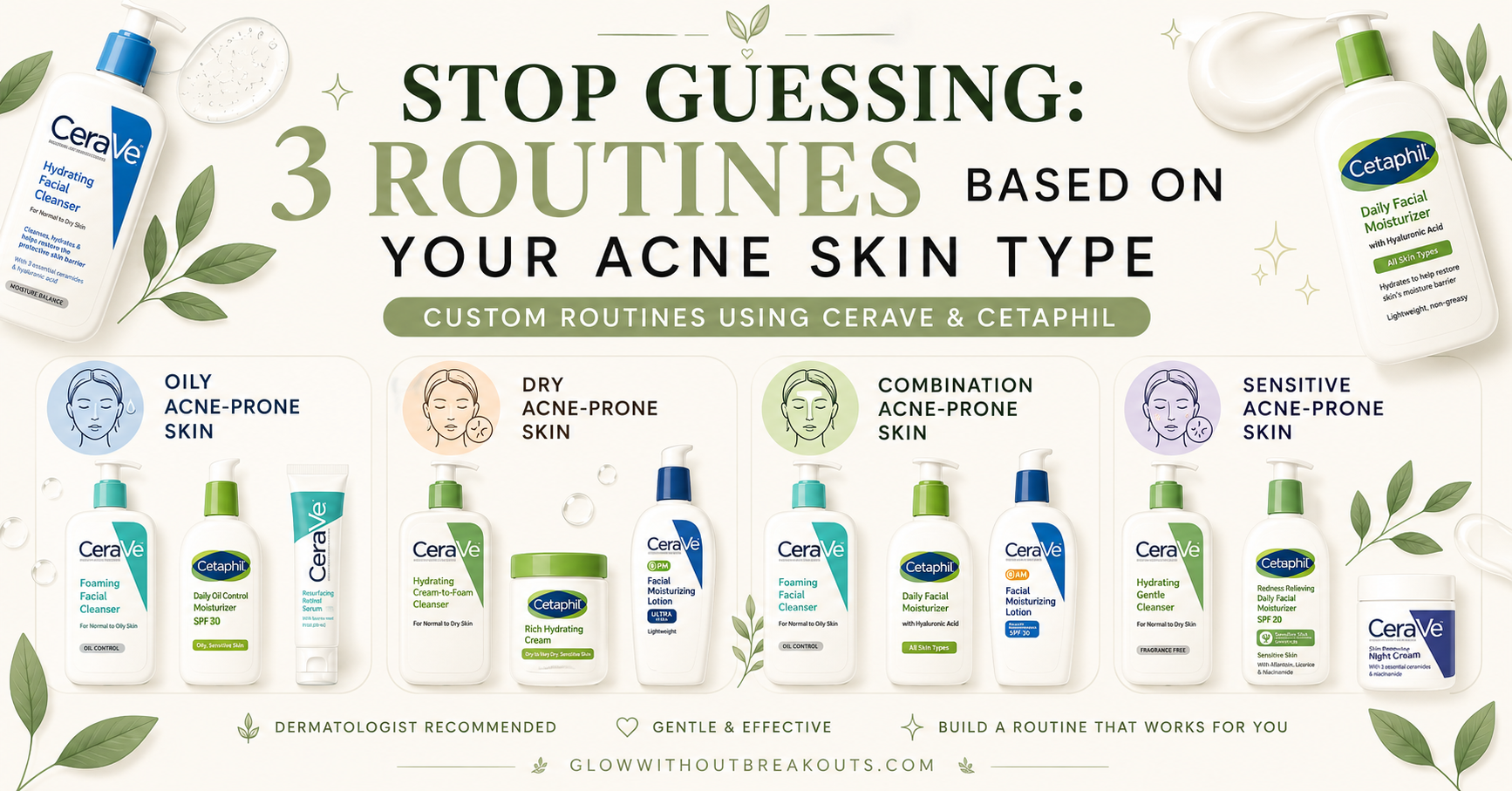
GlowWithoutBreakouts.com • Routines Based on Your Acne Skin Type • Updated 2026
If you’ve ever bought a cleanser that worked for your friend and completely broke you out, this post is for you. These are routines based on your acne skin type, not a generic one-size-fits-all list. Building a skincare routine for acne-prone skin isn’t just about finding good products: it’s about finding the right products for YOUR specific skin type. What clears oily skin can destroy dry skin, and what soothes sensitive skin won’t touch an oily breakout zone.
These routines aren’t pulled from a marketing brochure, they’re built from real experience, real money spent, and real results. Each skin type gets 3 routines based on your acne skin type so you can choose based on where your skin is right now.
Table of Contents
GWB Skin Quiz
Not sure what skin type you have?
Take the free 9-question quiz and find out in under 2 minutes.
These are routines based on your acne skin type, built from years of personal testing with real money spent. Before you start, it helps to know exactly which products work best for each routine.
Start here
7 Brutal Rounds: CeraVe vs Cetaphil — Advice From the Lab Rat
Also helpful
Best Cleansers for Acne-Prone Skin: Tested & Ranked
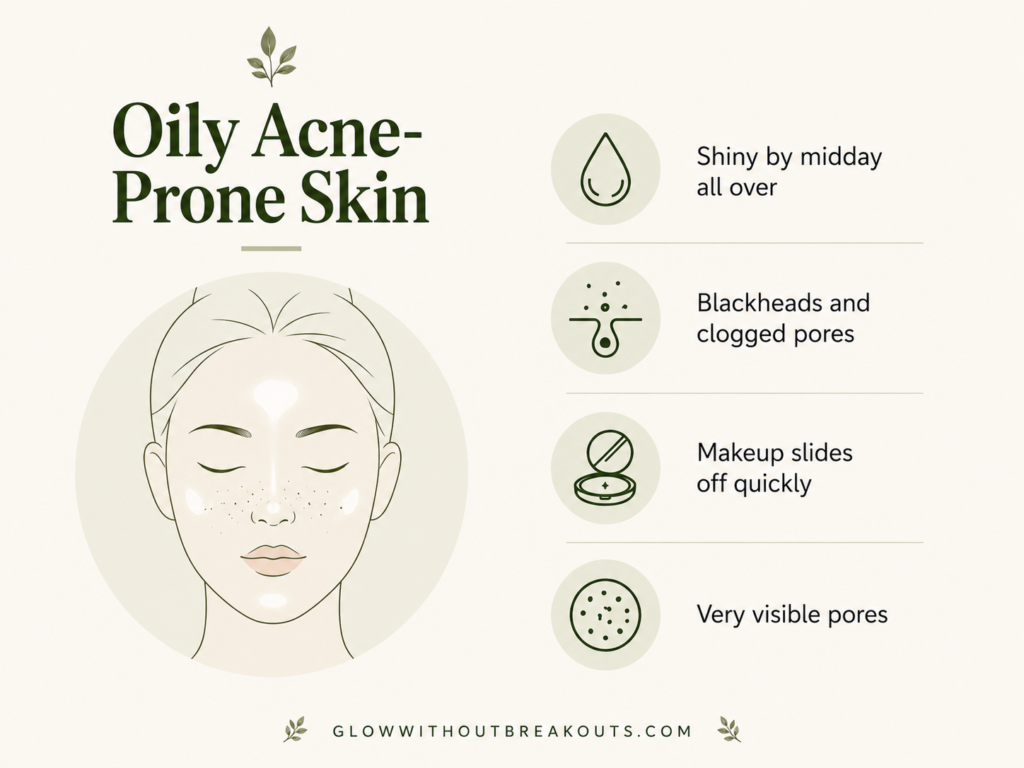
🛢️ Oily Acne-Prone Skin Routines
If oily is your skin type, these are the routines based on your acne skin type that will actually make a difference. Oily skin does best with foaming or gel cleansers that cut through sebum without stripping your barrier. Pair that with a lightweight lotion or gel moisturizer, and skip the heavy creams entirely: they’ll just sit on top and clog things up. For actives, salicylic acid is your daily go-to for keeping pores clear, and benzoyl peroxide is your heavy hitter when breakouts get serious. Anything with a mattifying or oil-absorbing finish is a major bonus for daytime.
Related reading
Best Cleansers for Acne-Prone Skin: Tested & Ranked
Routine 1: Best for Active Breakouts 🔥
When your skin is in full breakout mode and you need to see results fast, this is the routine. It leans on the strongest actives from both brands: the key is rotating them so your skin gets the clearing power without getting overwhelmed.
💡 Pro Tip: Never use the 10% BPO wash more than once per 24 hours, night use only. Start 2x per week and increase slowly, always follow with moisturizer: even oily skin needs hydration or it overcompensates with more oil.
Related reading
Best Ways to Make a Pimple Go Away Fast
Routine 2: Best for Daily Prevention & Maintenance 🌿
Once your skin is mostly clear, the last thing you want to do is keep hammering it with strong actives. This routine is gentler, designed to maintain that clear skin and prevent new breakouts without the intensity of Routine 1.
💡 Pro Tip: On nights you use the SA exfoliating lotion, skip the Clarifying Cleanser: never layer two SA products in the same routine. Alternate nights to keep your barrier healthy and avoid over-exfoliation.
Related reading
5 Critical Mistakes That Shattered Your Skin Barrier
Routine 3: Best Budget Routine 💰
You don’t need to spend a fortune to get real results. This is the most affordable combination of products that still actually works for oily acne-prone skin, and it costs less than most single luxury skincare products.
💰 Budget Breakdown
- Cetaphil Daily Facial Cleanser 16oz: ~$13.99 — lasts 3-4 months
- CeraVe AM Facial Moisturizing Lotion SPF 50 3oz: ~$19.99 — lasts 2-3 months
- CeraVe PM Facial Moisturizing Lotion 3oz: ~$19.99 — lasts 2-3 months
- Cetaphil Fast Rescue Pimple Patches 24ct: ~$8.99 — lasts 1-2 months
Total: ~$62.96 | ~$20-25/month
💡 Pro Tip: This 4-product budget routine costs under $65 total and each product lasts 2-4 months, less than most single luxury skincare products. Start here if you’re new to building a routine and want to see results before investing more.
Related reading
8 Best Tips to Prevent Breakouts and Acne
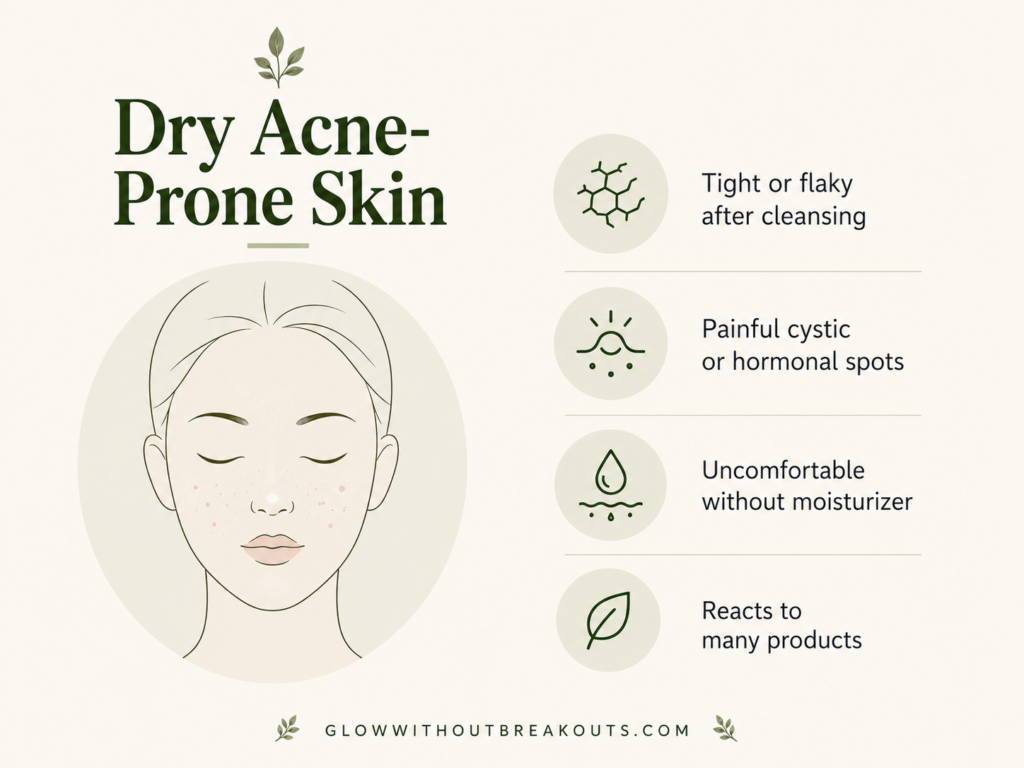
💧 Dry Acne-Prone Skin Routines
Dry acne-prone skin is one of the most misunderstood types. These routines based on your acne skin type are specifically designed to hydrate and clear at the same time. For dry acne-prone skin, your cleanser needs to be as gentle as possible: non-foaming or creamy formulas that clean without stripping a single drop of moisture. Follow that with a rich ceramide-based moisturizer that actually rebuilds your barrier. When it comes to actives, go low and slow, meaning low concentrations, one product at a time, never stacking. And if you’re using retinol, the moisturizer sandwich method is non-negotiable for dry skin.
Related reading
The Worst Skincare Mistake I Made: And How to Repair Your Barrier
Routine 1: Best for Active Breakouts 🔥
The challenge with dry acne-prone skin is that most acne-fighting products are too stripping. This routine targets active breakouts while keeping your moisture levels up, because without hydration, nothing else you put on your skin will work the way it should.
💡 Pro Tip: For dry skin, avoid the 10% BPO wash: it is too stripping. Stick to the 2% SA cleanser and spot treat only with the Acne Control Gel. If your skin still feels tight after cleansing, switch to the Cetaphil Daily Cleanser for PM too.
Routine 2: Best for Daily Prevention & Maintenance 🌿
This is your maintenance mode, the routine you settle into once things are mostly calm. No harsh actives, just consistent barrier support and gentle exfoliation that keeps skin clear without undoing all the hydration work you’ve been putting in.
💡 Pro Tip: For dry skin, 2x per week exfoliation is the absolute max. On exfoliation nights make your moisturizer layer extra generous to compensate. Wake up and your skin will feel smooth and balanced without that tight uncomfortable feeling.
Related reading
Over-Exfoliation Recovery: How to Fix Damaged Skin
Routine 3: Best for Post-Acne Marks & Texture ✨
Once your breakouts are under control, the thing that bothers most people is what’s left behind: dark marks, uneven texture, dullness. This is where retinol comes in: it’s the most powerful tool for post-acne skin, but for dry skin especially you have to introduce it carefully. The sandwich method is everything here.
💡 Pro Tip: This is the moisturizer sandwich method: moisturizer, retinol, moisturizer. It buffers the retinol so dry sensitive skin can actually tolerate it without irritation. I didn’t like this serum the first time I used it but once I used the sandwich method my skin completely changed after a couple of months. Start 2x per week only.
💰 Budget Breakdown (Post-Acne Marks)
- Cetaphil Daily Facial Cleanser 16oz: ~$13.99 — lasts 3-4 months
- CeraVe Daily Moisturizing Lotion 12oz: ~$14.99 — lasts 3-4 months
- CeraVe AM Facial Moisturizing Lotion SPF 50 3oz: ~$19.99 — lasts 2-3 months
- CeraVe PM Facial Moisturizing Lotion 3oz: ~$19.99 — lasts 2-3 months
- CeraVe Resurfacing Retinol Serum 1oz: ~$21.99 — lasts 3-4 months (used 2-3x/week)
Total: ~$90.95 | ~$22-30/month
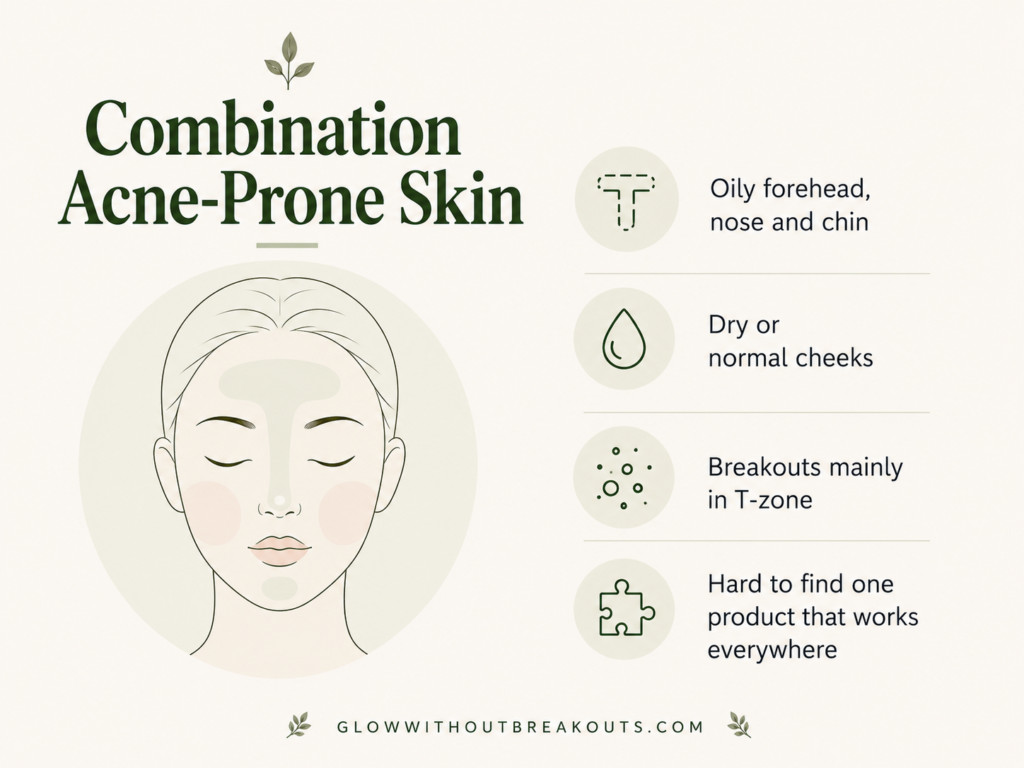
⚖️ Combination Acne-Prone Skin Routines
Combination skin needs a zoned approach. These routines based on your acne skin type treat your T-zone and cheeks as two separate areas that need two different levels of attention. Combination acne-prone skin is tricky because you’re essentially dealing with two different skin types on one face. The products that clear your T-zone can dry out your cheeks, and the products that hydrate your cheeks can make your T-zone break out. The key is simple: stop treating your whole face as one skin type and start treating it in zones.
Related reading
Does Stress Really Cause Acne? Here’s What the Science Says
Routine 1: Best for Active Breakouts 🔥
When your T-zone is clogged and actively breaking out, this is the routine. It puts the strong actives exactly where you need them, forehead, nose, chin, while leaving your drier areas alone. Zone application is everything for combination skin.
💡 Pro Tip: Zone your application: stronger actives like BPO and the Acne Control Gel go on the T-zone only. Your cheeks get the moisturizer treatment. Think of your face as two different skin types that need different amounts of attention.
Routine 2: Best for Daily Prevention & Maintenance 🌿
This is the routine you can actually stick to daily without feeling like you need a skincare PhD to apply it. It keeps your T-zone clear and your cheeks comfortable, without requiring you to use completely different products on different zones every single night.
💡 Pro Tip: If your T-zone still feels oily after this routine, try applying the Cetaphil Mattifying Moisturizer on just your T-zone and the CeraVe PM Lotion on your cheeks. Double moisturizing by zone sounds like a lot, but it’s one of the best things you can do for true combination skin.
Related reading
Best Pillowcase for Acne-Prone Skin: What’s Actually Breaking You Out at Night
Routine 3: Best Budget Routine 💰
This budget routine proves you don’t need to complicate combination skin. Three affordable products that cover both your oily and dry zones, and once you see results, you can build from here.
💰 Budget Breakdown
- Cetaphil Daily Facial Cleanser 16oz: ~$13.99 — lasts 3-4 months
- CeraVe AM Facial Moisturizing Lotion SPF 50 3oz: ~$19.99 — lasts 2-3 months
- CeraVe PM Facial Moisturizing Lotion 3oz: ~$19.99 — lasts 2-3 months
- Cetaphil Fast Rescue Pimple Patches 24ct: ~$8.99 — lasts 1-2 months
Total: ~$62.96 | ~$20-25/month
💡 Pro Tip: Once you see results with this starter routine, add the CeraVe Acne Control Gel as your next purchase, apply it on your T-zone only on clean dry skin before moisturizer. It’s one of the most effective upgrades for combination acne-prone skin.
🌸 Sensitive Acne-Prone Skin Routines
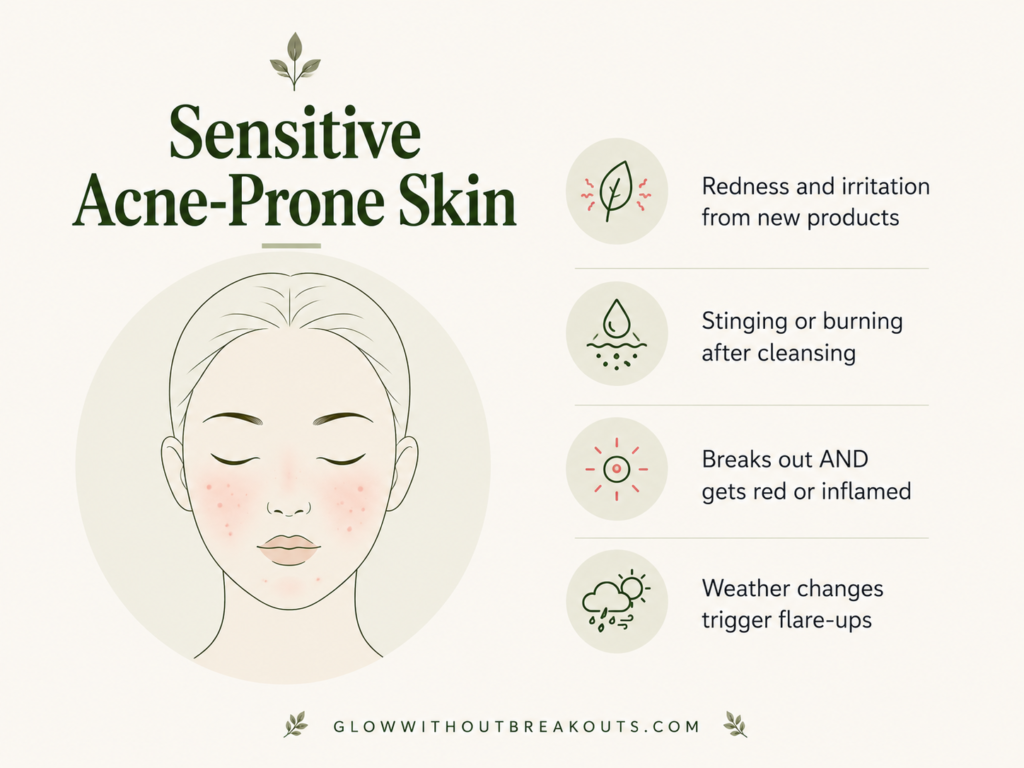
Sensitive acne-prone skin needs the most careful approach of all. These routines based on your acne skin type use the gentlest actives available so your skin can clear without reacting. Sensitive acne-prone skin has one non-negotiable: everything has to be fragrance-free, dye-free, and as gentle as possible. From there, ceramide-rich products are your foundation. When you do introduce actives, start with the lowest concentration available and add only one new product every two weeks. Patience is the most important ingredient in this whole routine. Results take longer for sensitive skin but they absolutely come.
Related reading
The Worst Skincare Mistake I Made: Barrier Repair for Acne
Routine 1: Best for Active Breakouts 🔥
This is for when you’re breaking out but every acne product you try makes things worse. Been there. This routine uses the gentlest possible actives to clear breakouts without triggering your sensitivity, and it keeps your barrier intact the whole time.
💡 Pro Tip: For sensitive skin, NEVER introduce more than one new product at a time, wait at least 2 full weeks before adding anything new so you can identify what triggers a reaction. Patch test everything on your jawline for 3 days before applying all over your face.
Routine 2: Best for Daily Prevention & Maintenance 🌿
This is your everyday calm, the routine that keeps breakouts from forming while keeping your skin as comfortable and settled as possible. It’s the gentlest routine on this entire list, and also one of the most consistent performers for reactive skin over time.
💡 Pro Tip: If the SA exfoliating lotion feels too strong at first, use the reverse sandwich method, apply moisturizer first, then the lotion on top: this buffers the active even more. As your barrier strengthens over weeks, switch to the regular method of applying on clean dry skin first.
Related reading
Over-Exfoliation Recovery: How to Know If You’ve Gone Too Far
Routine 3: Best for Barrier Repair + Clearing 🛡️
If your skin is tight, red, peeling, or losing its mind from previous harsh treatments, this routine is your reset button. I learned this the hard way: you cannot effectively treat acne on a damaged barrier. Repair first, treat second, always. Once your skin feels calm and normal again: then you add actives back in.
💡 Pro Tip: When your barrier is damaged, stop ALL actives for at least 2 weeks: no exfoliants, no retinol, no BPO, no SA. Just cleanse and moisturize with ceramides until your skin stops feeling reactive, then reintroduce actives one at a time starting with the very gentlest options only.
Read next
The Worst Skincare Mistake I Made: And How It Took 7 Years to Fix
💰 Budget Breakdown (Barrier Repair)
- Cetaphil Daily Facial Cleanser 16oz: ~$13.99 — lasts 3-4 months
- CeraVe Daily Moisturizing Lotion 12oz: ~$14.99 — lasts 3-4 months
- CeraVe PM Facial Moisturizing Lotion 3oz: ~$19.99 — lasts 2-3 months
Total: ~$48.97 | ~$13-17/month
Most affordable routine on the entire list — and one of the most effective for damaged sensitive skin.
📋 Quick Reference: All 12 Routines at a Glance
All 12 routines based on your acne skin type in one place. Find your skin type below and jump back up for the full details, pro tips, and shop bundles.
🛒 Where to Buy
Every one of these routines based on your acne skin type uses only CeraVe and Cetaphil products, available at every major retailer.
CeraVe on Amazon |
Cetaphil on Amazon
CeraVe at Target |
Cetaphil at Target
CeraVe at Walmart |
Cetaphil at Walmart
CeraVe Official Website |
Cetaphil Official Website
More From GlowWithoutBreakouts
Looking for more routines based on your acne skin type? These posts will help you build the best possible skincare routine.
→ 7 Brutal Rounds: CeraVe vs Cetaphil — Advice From the Lab Rat
→ Free GWB Skin Type Quiz
→ Best Cleansers for Acne-Prone Skin: Tested & Ranked
→ Best Sunscreen for Acne-Prone Skin
→ Over-Exfoliation Recovery: How to Fix Damaged Skin
→ 5 Critical Mistakes That Shattered Your Skin Barrier
→ Best Ways to Make a Pimple Go Away Fast
→ 8 Best Tips to Prevent Breakouts and Acne
→ Does Stress Really Cause Acne?
→ Best Pillowcase for Acne-Prone Skin
→ Best Oil Cleansers for Acne-Prone Skin
→ The Worst Skincare Mistake I Made
GWB Skin Quiz
Still not sure which routines based on your acne skin type are right for you?
Take the free 9-question quiz and get matched to your routine.
Disclaimer: This post contains affiliate links. If you purchase through these links, I may earn a small commission at no extra cost to you. All opinions are 100% my own and based on personal experience and honest research. This is not medical advice, please consult a dermatologist for persistent acne concerns.